A thousand years
of capital.
For over a millennium, Kyoto was the seat of emperors and the heart of Japanese art, faith and refinement. Spared the worst of the last century, it remains the country’s keeper of beauty — 17 World Heritage sites and counting.
Explore KyotoThe city that taught Japan how to be beautiful
Kyoto was Japan’s imperial capital for more than a thousand years, from 794 until 1869. In that time it gathered the country’s finest temples, gardens, crafts and cuisine — and because it was largely spared the destruction of the 20th century, much of it survives. Seventeen of its monuments are inscribed together as a single UNESCO World Heritage Site.
It is a city to slow down in: to watch raked gravel in a Zen garden, to walk a tunnel of vermilion torii up a sacred hill, to glimpse a geiko hurrying to an evening appointment through the wooden streets of Gion. This guide is laid out by area — east, west and center — plus the food and the easy trips that complete a Kyoto visit.
Eastern Kyoto — Higashiyama & the temple hills
Kyoto’s most atmospheric quarter: hillside temples, stone lanes, geisha streets and a tunnel of ten thousand torii.

Fushimi Inari Shrine
伏見稲荷大社The shrine of the rice god, where thousands of vermilion torii gates form tunnels winding up a sacred mountain. Each gate was donated by a business in thanks; the full loop to the summit takes 2–3 hours.

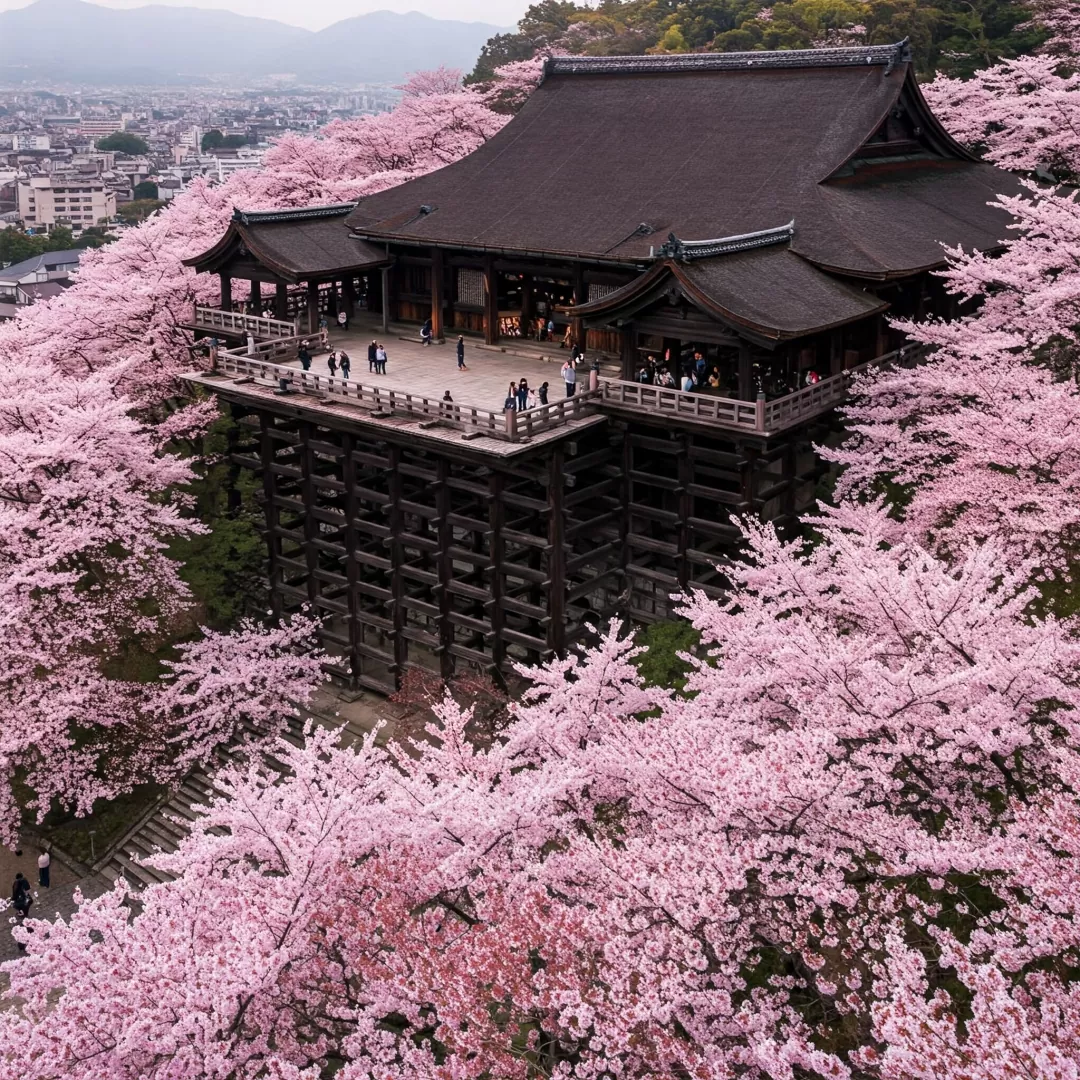
Kiyomizu-dera
清水寺A vast wooden temple whose famous veranda juts out over the hillside on towering pillars — built without a single nail. The view over Kyoto is one of the city’s defining images.

Gion Geisha District
祇園Kyoto’s famous entertainment quarter, where lantern-lit wooden teahouses line the streets and, at dusk, you may glimpse a geiko or maiko on her way to an appointment.

Ginkaku-ji & Philosopher’s Path
銀閣寺・哲学の道The understated “Silver Pavilion” and its sculpted sand garden, linked to the temple district by the Philosopher’s Path — a canal-side walk lined with cherry trees, named for a professor who strolled it daily.

Nanzen-ji
南禅寺A grand Zen temple at the foot of the eastern hills, with a colossal wooden gate, serene sub-temple gardens, and a surprising red-brick Meiji-era aqueduct running through the grounds.

Yasaka Shrine & Maruyama Park
八坂神社・円山公園The vermilion shrine that anchors Gion, lit by hundreds of lanterns at night, beside Kyoto’s favorite cherry-blossom park. Host of the city’s grand summer Gion Festival.
West & North — Arashiyama and the golden temples
Bamboo groves and riverside scenery to the west; Kyoto’s two most dazzling temples and its most famous Zen garden to the north.

Arashiyama Bamboo Grove
嵐山 竹林A path through towering bamboo that filters the sunlight green and creaks gently in the wind. Beyond it lie Tenryu-ji temple, riverside walks and the monkey park on the hill above.

Kinkaku-ji (Golden Pavilion)
金閣寺A three-story pavilion sheathed in gold leaf, mirrored in the still pond before it — perhaps the single most iconic image of Kyoto. Set in a classic strolling garden.

Ryoan-ji Rock Garden
龍安寺Japan’s most famous Zen garden: fifteen stones set in raked white gravel, arranged so that from any viewpoint one stone is always hidden. A space made for quiet contemplation.

Tenryu-ji
天龍寺Arashiyama’s principal Zen temple and a World Heritage site, with a celebrated pond garden that “borrows” the surrounding mountains as part of its composition — designed over 700 years ago.

Togetsukyo Bridge & River
渡月橋The “Moon-Crossing Bridge” spanning the Katsura River, framed by hills that blaze with color in autumn and soften with blossom in spring. Hire a rowboat or ride the scenic train upriver.

Kurama & Kibune
鞍馬・貴船A forested mountain escape north of the city: a hike over a wooded pass between a mountain temple and a riverside shrine, with hot springs and, in summer, dining on platforms above the cool stream.
Central Kyoto — palaces, markets & craft
The flat heart of the old capital: imperial grounds, a samurai castle, a kitchen market and the living crafts of a thousand years.

Nijo Castle
二条城The Kyoto residence of the shoguns, ringed by moats and gardens. Its palace is famous for “nightingale floors” that chirp underfoot — an ingenious alarm against intruders.

Nishiki Market
錦市場“Kyoto’s Kitchen”: a narrow covered arcade of more than a hundred stalls selling pickles, tofu, sweets, knives and seafood — many run by the same families for generations.

Kyoto Imperial Palace
京都御所The emperors’ home until the capital moved to Tokyo, set in a vast public park. The elegant halls and gardens are open to visitors free of charge.

Pontocho Alley
先斗町A single lantern-lit lane barely wide enough for two, packed with restaurants from tiny counters to refined kaiseki houses. In summer, terraces open over the Kamo River.

Kamo River Banks
鴨川The green spine of the city, where students, couples and families gather on the grassy banks. A walk or cycle along the water is the most local way to cross Kyoto.

Kyoto Crafts & Kimono
伝統工芸Kyoto is Japan’s craft capital: Nishijin silk weaving, Kiyomizu pottery, lacquer, fans and incense. Try a workshop, or rent a kimono and walk the old streets in style.
The most refined table in Japan
Kaiseki 懐石
Japan’s haute cuisine, born in Kyoto: a seasonal procession of small, exquisite courses that turns a meal into an art form. The city’s defining dining experience.
Yudofu 湯豆腐
Simple simmered tofu, a specialty of the temple districts — proof of how much Kyoto can coax from the plainest ingredient. Often served near Nanzen-ji and Arashiyama.
Obanzai おばんざい
Kyoto home cooking: humble, seasonal side dishes built around local vegetables and the city’s famous pickles. The everyday counterpart to formal kaiseki.
Shojin Ryori 精進料理
The Buddhist temple cuisine — entirely plant-based, balanced and beautiful — developed by Kyoto’s Zen monasteries over centuries.
Matcha & Wagashi 抹茶・和菓子
The home of the tea ceremony. Whisked green matcha paired with delicate seasonal sweets, served in teahouses across the city — and at their source in nearby Uji.
Tofu, Yuba & Pickles 湯葉・漬物
Silky yuba (tofu skin), countless kinds of tsukemono pickles, and delicate sweets — the subtle, vegetable-forward flavors that define the Kyoto palate.
Easy Escapes — Beyond the Old Capital
Ancient Nara, the tea hills of Uji and the lake town of Otsu — all under an hour away by train.

Nara
奈良Japan’s capital before Kyoto, 45 minutes away. Meet the freely roaming deer of Nara Park and stand before the Great Buddha of Todai-ji, housed in one of the largest wooden buildings on earth.

Uji
宇治Japan’s most famous green-tea town, just south of Kyoto. Home of the Phoenix Hall of Byodo-in — the temple pictured on the 10-yen coin — and riverside teahouses serving the finest matcha.

Otsu & Lake Biwa
大津・琵琶湖Just over the eastern hills lies Japan’s largest lake. Visit the lakeside temple of Ishiyama-dera, ride a pleasure boat, or take the ropeway up Mt. Hiei to the great monastery of Enryaku-ji.
A classic 3-day route
East
Higashiyama temple hills
Start at dawn at Fushimi Inari’s torii tunnels, then up to Kiyomizu-dera and down through the Sannenzaka lanes. Afternoon along the Philosopher’s Path to Ginkaku-ji, and an evening stroll through Gion to Yasaka Shrine.
West & North
Bamboo and gold
Early to the Arashiyama bamboo grove and Tenryu-ji, then the riverside and the scenic train. Afternoon north to the Golden Pavilion (Kinkaku-ji) and the rock garden of Ryoan-ji. Dinner in Pontocho alley.
Center or Escape
City heart or a day in Nara
Either explore central Kyoto — Nijo Castle, Nishiki Market and a craft workshop — or take the train to Nara for the Great Buddha and the deer park. Finish with a kaiseki dinner or matcha and sweets.
Kyoto is the cultural anchor of the Kansai region — Osaka, Nara and Kobe are all within an hour.
Getting there & getting around
Getting There
- From Tokyo — Tokaido Shinkansen to Kyoto in ~2h15m
- From Kansai Airport (KIX) — Haruka express ~75–90 min
- JR Pass — covers the shinkansen and the Haruka airport express
Getting Around
- Buses — reach most temples but can be slow and crowded at peak times
- Subway & trains — two metro lines plus private railways to Arashiyama, Fushimi and beyond
- Bicycle — flat central Kyoto is ideal for cycling along the Kamo River
Best Seasons
- Late Mar–Apr — cherry blossom; the city’s busiest, most beautiful weeks
- Nov — spectacular autumn foliage at the temples
- Jul — the grand Gion Matsuri festival
- Winter — quietest season; temples dusted with rare snow
Step into a thousand years.
Temple-hopping at dawn, a kaiseki dinner, a day among Nara’s deer — let us help you shape the Kyoto trip you’ll never forget.
Plan my Kyoto trip